Read more: guinea fowl,how to cook,venison,wild bird stew,red wine sauce,fried bream,grilled bream,okavango bream,okavango,botswana,botswana cooking,african cooking,african food,african cuisine,african dishes,pork ribs,how to cook pork,how to cook ribs,how to cook pork ribs,how to cook guinea fowl,how to cook perfect,perfect,tender,spatchcock,spatched,braaied,braai,barbeque,barbecu,barbecued,barbequed,prawns,peri peri prawns,peri peri chicken,mozambique food,mozambique cuisine,air gun hunting,air rifle hunting,gutting African Style Cuisine

Tuesday, 17 November 2020

Cooking posh with basic african camp equipment

Here's where African Style cooking all began. I had two cast iron pots and arrived in Botswana in 1999. We camped in two tents and built an open air shower cubicle( actually a bucket bath cubicle!) and had a simple Pit Latrine. Life was simple and good. 

Perfectly cooked spatched whole chicken on the braai.

Once again, another Italian friend, Vito, helped me perfect this method of cooking chicken on the braai. It is one of the most difficult meats to cook successfully. It is either raw inside or blackened and bitter outside. My way, the flesh stays moist and even the joints on the bones are soft.

Casserole of Guinea fowl, Francolin or wild duck


Monday, 9 November 2020

Spatch Cock Chicken over The Coals and Fried Rice


Like so many South African recipes, this main meal is derived from many cultures. The peri-peri spatchcock chicken has sort of Mozambique overtones. The fried rice is not strictly African but might have influences of the Cape Malay cuisine of Cape Town.
I have combined the two dishes to make the main meal because they complement one another so well.
By the way..the three sirloin steaks tucked around the edge of the spatchcock on the grill was for a guest that preferred beef! They have nothing to do with this recipe and were merely basted with olive oil and fresh rosemary Italian style.

Saturday, 25 January 2020

shoot and cook

I'm about to embark on an eco-friendly shoot and cook series. Watch this spot. Coming soon. I have a lot of footage and pics but do not quite have enough material yet. We will get there soon I promise!
I'm looking forward to wild dove and guinea fowl recipes being published very soon. After endless tweaking of my Air rifle which the kids have been using... I finally got to the point where I was happy to harvest African turtle doves and other dove species ethically and painlessly...That meat vital shots. I made it! I have slowly been building up a kg of dove breast to create a superb African style dove in a cream dish. I'm working on the details, but start off with getting 12 dove breasts for 4 servings. I'm nearly there! Let's do this together!

Monday, 24 December 2012

Garlic and Rosemary stuffed Leg of Lamb


A recent comment on my last blog by Minasek inspired me to try something with Lamb! Thanks for the nudge!

This is not really a new idea, but for those who may be struggling to get a tender well-cooked Lamb roast, this recipe works really well. It can also be a complete meal in one Baking dish. I added Butternut, mushrooms, baby potatoes, Beetroot, and aubergine for the last hour and a half. Total cooking time was two and a half hours at 190C/370F
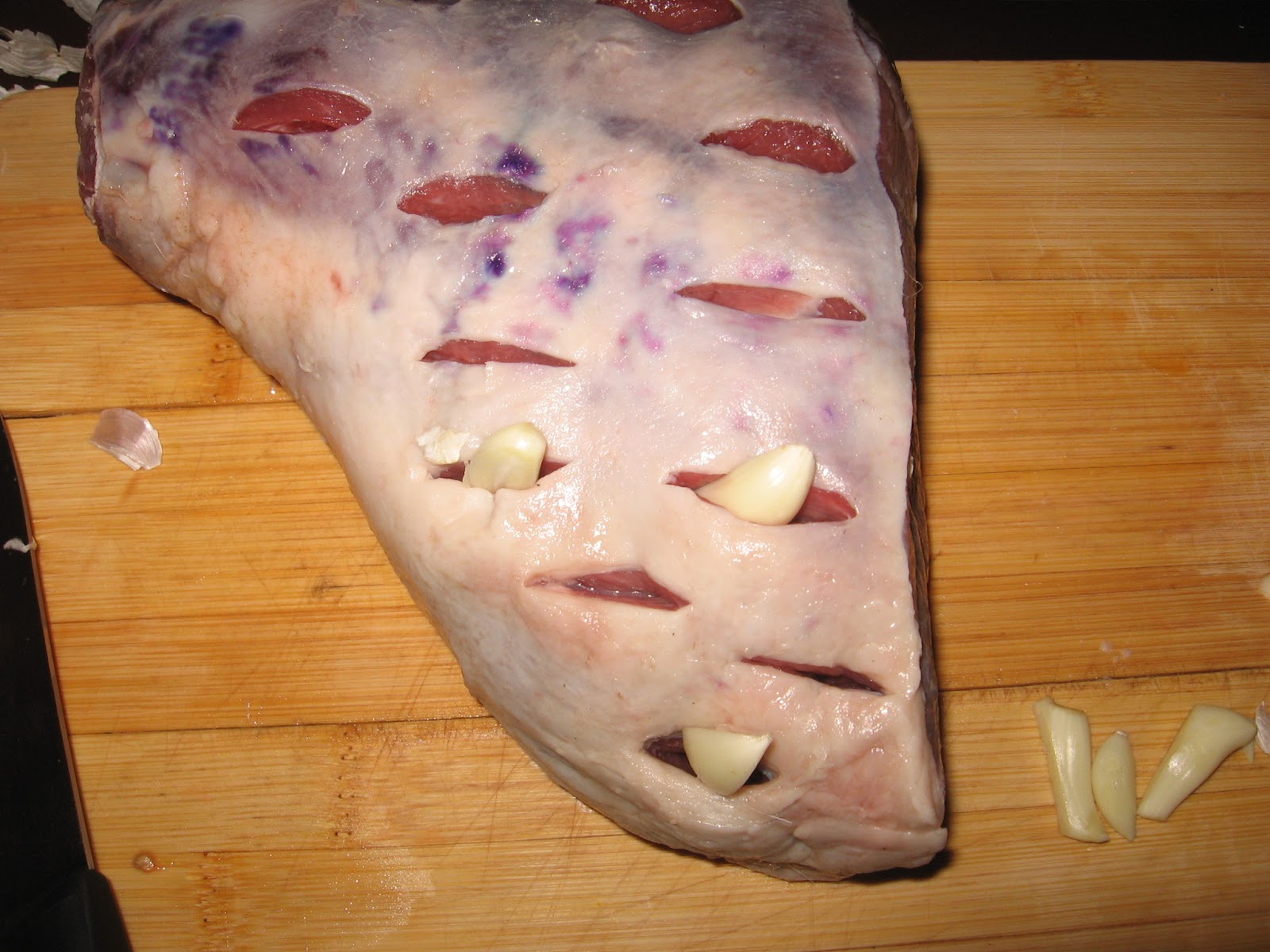
Wash and pat Dry your Leg of Lamb and using a Chefs Knife or a broad blade knife make incisions all over the top side of the roast. Push the tip of the knife straight down until it reaches the cutting board. Then fill each incision with fresh garlic and Rosemary. I had to use dried Rosemary this weekend because I had no fresh. It worked out fine. You could also use fresh thyme instead of Rosemary. Thyme goes really well with Lamb. Don't ever mix such dominant flavors though. Sprinkle and press fresh ground black pepper and more rosemary over the leg and put it into a large roasting pan.
Then stuff with garlic and Herbs.....
Into the oven for two and a half hours. If it looks like it is burning a bit during the cooking then cover the top of the meat only with a little silver foil. Ovens vary. Add the roast vegetables for the last hour and a half.
Then using the pan juices make your gravy. I skimmed off most of the fat and added a glass of white Chardonnay and thickened it with a little flour paste. Season carefully and don't be afraid to add a dash of Balsamic vinegar or a teaspoon of brown sugar or jam to get a nice tang. I did!


Tuesday, 18 December 2012

Spinach, Mushroom and Herb stuffed Beef


Here is a very elegant meal that can be made for a special occasion. It is something a bit beyond the normal Sunday Roast and you will definitely get lots of "Wows" because it looks good, is meltingly tender, and tastes incredible!

Buy the very best Beef you can afford. For this recipe, I recommend a large whole rump. I made the pictured rolled roast with a 4kg prime rump. Always buy meat with white fat and plenty of it. It will melt off during roasting and you can trim any off that you don't want.

You will need:
3 to 4 kg whole rump
250 grams of sliced button mushrooms. (slice to keep the mushroom profile)
250 grams chopped bacon
2 cups cooked and drained chopped swiss chard or spinach.
150ml cream
A cup of chopped leeks or onion. (Leeks make for something a little interesting)
about 20 pieces of garlic chopped.
Fresh rosemary sprigs
Fresh thyme or dried.
Two teaspoons ground black pepper.
Some cotton string

Start by cutting the roast into a long flat slab. I do that by cutting ALONG the grain, NOT across it. Cut down about an inch and then keep cutting to make an unrolled roast. The best way I can describe this is to think of a swiss roll cake.
You are going to put the spinach/bacon stuffing in instead of Jam!

Start by frying the bacon, leeks, and mushrooms together. Add the spinach and cream and reduce it until there is almost no liquid.  Be careful not to burn it. Use a thick bottom pan or pot and very low heat and be patient. You can also add a little flour paste to thicken, but be careful not to mush up the texture.

Finally un-roll your Beef Rump on a flat surface. Spread the filling over it evenly. sprinkle a little dried thyme and a few sprigs of Rosemary on. Sprinkle the raw garlic on. Add any other seasoning that you like at this time like the black pepper. I always avoid putting salt in during any cooking because it tends to draw out juices. Keep the filling a little back from the end of the roll otherwise, it squishes out when you roll and tie it.

Roll the rump back up and secure it with 3 or 4 cotton strings.

Place it in a large roasting dish, fat uppermost, and roast it for 3 hours at 200C (390F)  Baste with the juices every 30 minutes. If it looks like it is drying out (depends on the grade of beef) cover just the top of the meat with a square of foil. In the last hour add your roast veg. I used peeled and quartered Beetroot, large whole carrots, and butternut.
Finally, make your gravy out of the pan juices a cup of semi-sweet wine (add a little sugar or syrup if using a dry wine) and cornflour. Season and taste your gravy...it is a key to a perfect roast!

Sunday, 7 October 2012

Tiger Fish!

I have to digress slightly here! I have been on 10 days' leave and spent some of the time exploring the beautiful Chobe game reserve as well as fishing. The fishing has not been good. I have literally caught two in the entire 10 days. HOWEVER, the one I caught was this!


Nearly eight kilograms of Tiger Fish. Well because I fish strictly for food I am going to have an interesting time finding ways of preparing and cooking this. I will give at least half of it away to some Zimbabwean friends who love fish.

I will blog as I turn this fish into delicious meals. In the meantime, like all other base lying fishermen I have to tell you the story of catching this particular fish! As I am not a sport fisherman, I do not have an accurate scale, but this fish weighs 7kg on our new bathroom scale. I think it is closer to 8kg. As Tiger Fish go in our region, that is way above average for fish caught here. A good fish is often 3 maybe 4kg. A fish this size is not particularly the best meat. However, I was compelled to kill it due to a bite it sustained from a crocodile whilst I was landing it. No jokes and this is not a fisherman's tale! Here goes.
I was spinning using a spoon I designed and made myself. Here it is.


After a fairly classic smashing strike, the fish ran off about 120 meters of line. I was using an 8kg braided line. A very dodgy line I have had some breakages with so I was playing the fish very carefully. I had a few airborne leaps but tried to avoid them by giving a bit of slack when I saw the line angling towards the surface. After 35 minutes the fish was close by. The water shallowed and there were a lot of rocks I had to steer the fish through. The fish was splashing around a lot and it must have attracted some crocodiles. All of a sudden there was a crashing of spray and a huge croc lunged at the fish and grabbed it just behind the gills. I screamed and waved my hands and fortunately, the croc was as surprised as I was and dropped the fish and plunged back. At this point, I noticed 3 other crocs, all-around 10 or 12 feet on the surface surrounding the action. Here is one my daughter photographed last week the same size.

The big one I had just driven off didn't go far but circled and began coming in again. Well, all this was happening in seconds! Adrenaline was rushing, my heart was pumping! Holding the rod with one hand I managed to pick up rocks and hurl them at the crocs until they submerged. Not sure if that was a good idea because I didn't know where they were now. To cut a long story short I managed to tussle the fish over the rocks to a fairly rocky place in the water where I hoped I was protected from the crocs. I managed to get hold of the steel trace and towed the fish onto the bank where I dispatched it. Fortunately, the bite from the croc did not damage much meat. I had to carry that fish nearly a kilometer to reach the car on shaking legs.

Saturday, 6 October 2012

Pork and Beef Shish Kebabs


Over the last couple of months, I have prepared and perfected a kebab recipe to my liking.  Shish kebab is the Armenian word for "skewer," It is a dish consisting of meat threaded on a skewer and grilled. Any kind of meat may be used; cubes of fruit or vegetables are often threaded on the spit as well. Typical vegetables include tomato, bell pepper, onions, and mushrooms.
In Southern Africa, they are often made using pork, beef, lamb, and chicken. Onion slices, bell pepper, pineapple, and mushrooms are often added to the skewer. I love a mixture of vegetables and meat with something sweet also added. On different occasions have used plum slices, peach slices, and pineapple.
 Photo courtesy Jenn whos photo was better than mine and whose excellent recipe is here
I always cook Shish Kebabs over wood coals, but of course, it can be done over charcoal, gas, or in the oven. Try and just "catch" the caramel sauce so that you get a very slight charring.

The marinade is quite important and there are many variations. Here is a recipe that works really well and I recently prepared for my family visiting from New Zealand and Zimbabwe.

Serves 6 with plenty of left-overs

Ingredients

1kg pork fillet, leg chops, shoulder, or whatever cut is cheap. I used leg chops. Cut into matchbox size chunks.
1 kg of beef rump steak. You can also use ribeye or fillet. Cut into matchbox size chunks.
3 onions cut in half lengthways and separated into flakes. Then spend a bit of time trimming the flakes to roughly round shapes, sort of matchbox size.
1 large bell pepper also cut to round matchbox sizes
20 button mushrooms, stalks removed or trimmed flush
(by the way, keep all the above trimmings in the fridge for a soup, stew, or similar dish)
Pineapple slices cut into suitable matchbox size rounds. I use fresh pineapple if available. Try peach halves if you can get them, either canned or fresh.

marinade ingredients

2 tablespoons balsamic vinegar
2 tablespoons red wine vinegar
2 tablespoons tomato puree concentrate.
half cup good red wine. Cabernet or Pinotage or a Claret
half cup brown sugar or preferably honey.
about 2 tablespoons grated fresh garlic
about 2 tablespoons grated fresh ginger
3 chilies chopped finely
Pinch of ground cloves.
1 tablespoon finely chopped fresh rosemary.
2 teaspoons salt.

Method

Mix the marinade ingredients well making sure all the sugar is dissolved. Put the meat cubes into the marinade and then toss them every hour or so for a whole day. (Start this in the morning if you are going to barbeque in the evening)

Starting with meat alternately skewer pork, pineapple, beef, onion, mushroom, pork, pepper, etc. Obviously, this order is entirely up to your taste, but as a general guide, pork is best next to the sweet pineapple or other fruit and beef next to savory onion or pepper.
I then pile all the shish kebabs up on a dish and pour the marinade over them a few times.

Put the marinade into a small saucepan and add a quarter cup of good olive oil. (this will prevent the meat from drying out during cooking) make a roux of one heaped teaspoon of flour mixed with a little water and add stir it into the sauce. Bring to the boil, stirring constantly, and reduce to a thick sauce. This what you baste onto the shish kebabs while cooking. If you don't have a basting brush, GET ONE! It is invaluable for so many types of cooking. After trying many I have found a 2-inch pure bristle paintbrush works best.


Next. Get cooking and basting. Turn the skewers once or twice and try and end up slightly burning some tips and edges of the meat for flavor.
 I served these with sweetcorn boiled and tumbled in butter, cracked black pepper, and a teaspoon of lemon zest.

photo credit Emily of food porn

Monday, 6 August 2012

Lambassa's Cameroon Chicken

This is really a great looking and a genuine African recipe. It come from a little further North than strictly Southern Africa, but it is so similar to many of our ethnic chicken dishes that I thought I would include it. Visit her blog at lambassaa It is in French but is easy to follow. If you prefer, use Google translate which is found here
She has beautiful step by step photos of the preparation. Give it a go! try a little taste of real Africa!
Here is her finished dish.

Saturday, 28 July 2012

Pork Hock Ragoût with Cabbage

This is a favorite cut of pork for me. It is also one of the cheapest and tastiest pork cuts. The bone and gristle and skin break down during slow cooking to make a rich succulent broth. I call it a  Ragoût because I had some Fench  influence when I was researching it. It also meets my "Health Food" requirements because the Skin and fat is skimmed off before serving, leaving very little fat.
Here you see it half way through cooking...
And here it is for the final 30 minute after removing the fat and adding the cabbage and baby peas...
Ingredients:

1 large pork hock or 2 or three pigs trotters (with hoofy bits removed please!)
1 large carrot peeled and cut into rounds.
2 medium onions chopped coarsely
1 cup fresh or frozen baby peas.
3 cups chopped cabbage.
6 or 7 fresh green curry leaves. (this is a bit of a secret ingredient for a unique flavour and is rather special, however 7 or 8 bay leaves can be used instead)
5 garlic segments chopped
1 heaped tablespoon fresh grated ginger.
1 chopped green chilly. I would use 3 but my wife does not like spicy food.
1 glass sweet or semi sweet wine.
Method:

It very simple really and is a dish that can be left to "Get On With Itself"
Cook the onions in a little oil until lightly browned. Add the Hock, the carrots, and cover with water and the glass of sweet wine. Sprinkle the herbs and garlic on top and arrange the curry leaves so that they are easy to remove during cooking. Now bring to simmer for 3 hours. Let the liquid reduce as much as possible without burning the meat. Half way through remove the curry leaves or leave in longer according to taste. Halfway though is about right though. Let it cool slightly and then break up all the meat. Remove the bones and skin and any floating fat. Leave a few globules floating though because a lot of the aromatic oils found in the herbs are trapped in the fat. Add the chopped cabbage and baby peas and bring back to simmer for a further 30 to 40 minutes until the vegetables are tender. Carefully turn the vegetables into the meat broth during this final cooking. Season to taste and serve.
I served this last week as a savory relish with Firm Polenta. We call it Sadza or Nshima in our region.

Wednesday, 11 July 2012

Lasagna a la Roger


I am happy to say that all three of my boys have followed my love of cuisine and producing special meals. Roger is a talented Wild Life Artist and his artistic streak has affected his cooking too! Visit his blog , Roger Brown Art of The Wild. It is in my links on the right hand side of this page.
There are many cultural influences that have caused the slow evolution of uniquely Southern African food, and Italian is one of them. There are many Italians in Southern Africa. However in the early years many of the real Italian ingredients were not always found very easily. Things like Roma tomatoes, the proper pungent purple garlic, fresh pesto ingredients and even the right flour to make Pasta.
South African cooks improvised. Here is Rogers version of Lasagna. His addition of pork sausage meat makes this particularly tasty. He has used easily available dried herbs and canned tomatoes.
Ingredients:


Meat sauce
500 g lean beef mince
500g pork sausages
800g tin chopped tomatoes
2 onions
Heaped tespoon dried Origanum (half cup chopped fresh if available)
Sweet basil (half cup chopped fresh if available)
3 cloves garlic
Salt black
Pepper
250g Lasagne sheets
White sauce
1 litre milk
2 large table spoons butter
2 table spoons cake flour
Black pepper heaped teaspoon.
Salt
Half cup grated mozarella and cheddar mixed.

Method
Start off frying the onions in a little olive oil
Add chopped up pork sausages and then the mince ,brown them well.

Add garlic, origanum and sweet basil and the salt and a tablespoon of sugar
Once all brown  add the tinned tomatoes, tomatoe paste and tomatoe sauce
Let it simmer for about 30 min or more.


While that is simmering make the white sauce..
I do this by making a roux. Melt 2 tablespoons of butter on low heat ,then add 2 table spoons cake flour. Add the milk very slowly, adding more only when all lumps have been mixed out. Keep stirring continuously until thick then add salt and pepper and the grated cheese.

Put 3 cm layer of meat sauce in the bottom of a large rectangular baking dish. Then layer the lasagne sheets (Soak them in warm water for 5 min beforehand to soften)
Next layer white sauce then meat sauce then sheets and continue as many times possible. I normally get two layers of each. Finish layer should be white sauce with cheese on top. Grind fresh parmesan cheese over the top if you can get it. Bake in oven for 30 min or until top is well browned at 250C (480F)


Thursday, 5 July 2012

School Lunch Healthy Chicken and Chips with Peas


Chicken Chips and Peas is a very old favorite of mine. It was born by my English Grandma who used to give us this meal for lunch once a week after school!

I modified this recipe a bit to conform to my new health regime and yet I have to say it was still very similar to Grandmas lunch.
 Ingredients:
Serves two hungry schoolboys.
two large leg and thighs.
Cup of fresh or frozen green baby peas
About three medium potatoes peeled, chipped and parboiled till almost soft. (Yes par-boiled!)
minced or chopped garlic.
fresh ground black pepper.
Mild extra virgin olive oil. (Here's the healthy bit..no deep frying!!) Olive oil is actually GOOD for you.
Method
If using frozen chicken, first of all defrost thoroughly your chicken leg and thighs. It is best to do this overnight in the fridge.
Start the meal by getting the meat going.
Dash a little of the olive oil into a large pan which has a lid. Season with the ground pepper and rub the minced or chopped garlic over the meat. Start turning the heat up until the meat is just sizzling. It will probably be at about 25% of your dial. This is grandmas secret method. Very slow frying. Expect this to take an hour. 30 min on each side. Don't turn more than necessary. A certain amount of liquid will form, but leave the lid off long enough for it to steam off then resume with the lid on. This combination of frying/simmering in liquid is the key to truculently tender meat after about an hour.
Whilst this is going on, lay your parboiled chips out in an oven dish and drizzle a little olive oil over them. Shake and coat as best you can. Put into the oven at 200C (390F) Once its sizzling gently toss again and turn individual chips carefully to coat with the olive oil. Let them brown lightly, tossing as required.
AT THE SAME TIME!!! O' harassed cook, put your peas into a small saucepan with a lid and a teaspoon of REAL butter. Yup. our one exception to strictly healthy food. Baby peas without butter are just not worth eating in my opin! Again gentle heat until the butter melts and the peas steam cook for about 10 minutes.

Serve with ice cold coke in the bottle with a straw!

Tuesday, 26 June 2012

Health Food

I know my family, and especially my wife, is going to laughh at this post and the new category "Health Food" because we have a bit of a joke going on in our family, many years old. By the way, "Health food" as I have titled it, in my eyes represents the following: Crunchy stuff, hard nutty stuff, dry dusty bran, hard as stones dry raisins, tasteless soya stuff, plain boring meals stuffed full of strong spices and herbs to try and liven them up, no sauces, tons of brown or gritty looking rice etc etc ad nauseum!

You will no doubt conclude that I have had very very bad experiences with "health food" over the years.
But...BUT.. This must change. I am going to have to have a total re-think at this whole health food thing. A check up at the doctor two weeks back revealed that I have high blood presure and I need to do something about it.
So my mornings now start off panting and gasping and stumbling around in the half dark over my wifes skipping rope whilst trying to dream up tasty healthy meals which don't break my gastronomic spirit!

I have a few conflicts though. My cooking lore dictates that flavours are trapped and carried by fats. I also am an old fashioned cook that bases meals around meat and then add side dishes to balance the predominant flavour.
So... I am determined not to slide of into that demoralizing foggy area of tastless food bland veggies and no fats. Rather I will work hard to design meals that still contain meat, fish and poultry, but that are healthier (cholesterol wise) yet are still flavorsome and satisfying. Smaller meat portions will replace large and compensate for some of the less healthy components like a bit of butter, skins left on poultry, a nicely marbled beefsteak from time to time as well as pork, lamb and offal.
So expect some changes ahead! By the way I have learnt a lot from a fellow foodie blogger Adura, who like me is African (she black African and me White) and who blogs very practically about health, beauty and fitness as well as food. Her blog is here . Another, is a very gifted person, also an African, living out of Africa who prepares fantastic franco/african food with a Cameroonian theme. She is here..LAM BASSA'A

African people, especially those living in rural areas in Southern Africa are ten times more healthy than Westerners. You will note for example in Lambassa'a just how much natural ingredients she uses. Although living in London (or thereabouts I think!!) she sticks with what she knows.That is most likely how she was taught and brought up. Most African people here eat a lot of cereals, beans, root vegetable and fish. Meat is pretty much a luxury apart from fish and shellfish in some regions.

Anyway, look forward to some great but healthy food still with an African style in the blogs ahead.

Wednesday, 20 June 2012

Deep Fried Calamari Rings

Fried Calamari is a huge favorite seafood in Southern Africa. It is found on most restaurants menus. I cooked a batch this week and decided to share it here. Many people shy away from cooking it at home. This is often because of bad experiences with results. I must say at this stage that the length of cooking time and the temperature of the oil is of paramount importance. A few seconds in the oil too long and you get rubbery meat! There are actually very few restaurants that get it right either.

To start with, you need good quality fresh rings. I have found that the South African Breco brand of ready prepared quick frozen rings are of consistent quality and the right size. If you dont have to prepare and clean the whole Calamari yourself then dont!! Its messy, but I must tell you that the results are quite a bit better than using frozen.

Ingredients for 4 servings.

800g prepared cleaned rings.
fine fresh breadcrumbs
1 egg well beaten..
As you can see the ingredients are simple. It is the process that is tricky. Yet it is also simple...it just needs to be done a certain way.

Method

Dry the rings thouroughly. THIS IS VERY IMPORTANT. I do it by making a pouch by holding the 4 corners or a clean dry tea towel. Put the rings in and then toss the rings by patting upwards with the other hand. Keep doing this and even change the tea towel for a dry one. Take your time and do the job well. I do not put the rings into flour before egging and breading them. I find this way produces better results. The crumb coating sticks and sets more firmly and doesnt come off in the cooking.

Next drop the rings into the egg and then after coating them drop them into a pan of breadcrumbs. Shake and toss until well coated. Remove and leave to set for an hour at room temperature.

Put clean cooking oil onto heat and put one ring or a piece of one into the oil and wait for the oil to heat and brown the ring. When it is well browned turn your stove top to keep the temperature the same. I do it by turning the knob back slowly until I hear it click. Try it! It works every time and is the most foolproof way of getting the temperature right. Now cook in batches of 10 rings. They should not be in the pan for more than 50 to 60 seconds and should be removed when they are a pale straw. As a general rule, rather have oil too hot.
The best way of eating these in my opinion is with a simple gherkin and caper tartare sauce or a squeeze of fresh lemon.

Tuesday, 29 May 2012

Lamb Loin Chops ala Angie

In the last week we have enjoyed incredible South African Lamb. It has to be some of the most flavorsome and meltingly tender lamb available in the world! I think the only comparable lamb is found in countries like Greece and Turkey where the animals get to graze a lot of natural and aromatic herbs like wild sage.
My wife Angie, cooked such a simple, delicious meal of lamb chops last night, that I am inspired to record it here, as well as the barbecued version I did over the last weekend.

photo credits thanks to cavegirldish.com and huffingtonpost.com
All she did was place them in the oven, close under the grill for 30 minutes. I detected a dash of freshly ground black pepper. She served it with Mashed Butternut squash and fried potato cubes and it was really awesome. It humbled me a little because it reminded me that sometimes we tend to "overwork" our herbs and flavors.
With the same batch of Lamb Loin Chops, I put together a barbecue, or braai as we call it here in Southern Africa.
Mt lamb chops were sprinkled with chopped rosemary, freshly ground black pepper and a sprinkling of balsamic vinegar. This was then braaied over medium coals (strictly no flame) for about 10 minutes each side. They were INCREDIBLE! We ate them by the fireside with freshly roasted sweetcorn. Just that.

Monday, 21 May 2012

Mussels. Quick and very delicious!


Back to South African seafood..
Mussels in South Africa are still very cheap and easily found. They are frozen but that is fine. They are also farmed extensively and to be quite honest, the farmed mussels are far nicer than freshly collected in my opinion. Maybe its just because there is no grit, no beardy bits and no sore hands!! Just a tip for collected mussels. Put them in a netting bag overnight in a rock pool. They will purge any sand. Dont even try and pull off the beardy bits like all the cook books tell you...snip them off with kitchen scissors. To open and remove the half shell, just dump the mussels into a large pot of boiling water for a minute, then drain them. Use a small sharp knife and sever the muscle on the inside of one shell half and break off that same shell half. But like I said. Rather buy frozen prepared half shell mussels!


Ingredients:

For a good large snack or light meal for 4 people, use one and a half kilo of half shell mussels.
4 segments of finely chopped garlic
if you can get, fresh dill finely chopped
bread crumbs
cayenne pepper
250ml butter melted. You can also use a light olive oil which gives a whole different flavor slant. I often use half and half as I find butter a bit rich for me personally.

Melt the butter and add the garlic, black pepper and a pinch of cayenne pepper. DONT cook the garlic. You need pure flavor here.
Lay all the shells out on a baking tray and spoon the melted butter and garlic into each shell. Sprinkle with the chopped dill and a pinch of breadcrumbs which helps capture the juices. Grill until the mussels just start to shrink and serve immediately in the pan with fingers of fresh bread to mop up the juices! There will be No complaints I promise you!


Peri Peri Parcels

Well on the weekend I tried a slight variation on two of my recipes. Peri Peri Chicken and sticky pork ribs.
This makes them super succulent. As usual, slow cooking is the key.
Ingredients are not critical, but try my peri peri chicken recipe.
On two different days I wrapped pork rashers in foil and chicken legs and thighs in foil. The herbs and spices were as always, fresh grated ginger, chopped chillis and chopped garlic. You will see a sprinkling of fresh chopped basil on the pork rashers. It was an interesting flavor, but I am going to try it with Cilantro next time.The pork rashers were covered and tightly sealed with foil. The peri peri chicken, I wrapped completely in foil. Cooking time was about one and a half to two hours at 180 C. Then 20 minutes unwrapped under the grill to brown.

Wednesday, 2 May 2012

Crayfish/Lobster


Found on the West Coast as well as the East coast (different species) Rock Lobster or Crayfish are widely eaten. They are very similar to Lobsters and so are easily substituted if you are not from Africa.

It is best as always to use fresh or live Lobster. If live, merely drop them into a container of fresh water for 10 minutes. Painless, stress free for both Lobster and Cook! No stabbing in the right spot with knives etc!

If you are convinced of their freshness, frozen raw crayfish is also fine.
For the size commonly sold in Southern Africa (400g or about three quarter of a lb) you will need to drop them into briskly boiling water for 7 minutes. Put a cup of brown sugar into the water...it does all sorts of good things to the flavour! Remove and plunge into cold water and allow to drain on draining board. lightly larger Fish cook for 10 minutes. These are blanched semi cooked fish.

From here you need to twist off the tail from the abdomen firmly and draw it apart. Break off the claws and feelers and crack open the abdomen and rinse under flowing water. (all this if you have the patience to pick out the meat which I don't) Use kitchen shears and slip it under the carapace where it is broken from the body. Snip along the belly to the tail. Pull the shell away and reserve it for garnish.

Photo credit Andrew http://sjefhansen.wordpress.com

There are now a few ways of continuing. Check out this method by Chef Hansen who is an extremely promising South African Chef  here: Curried crayfish is a popular dish in Southern Africa, but it is more commonly eaten very simply with butter lemon and a touch of garlic.
Here is a variation that is delicious:
Ingredients:

4 prepared blanched tails (one per person.)
Whole lemon zest grated and juice reserved.
One heaped teaspoon chopped garlic. (never overpower the delicate flavor of the fish)
A heaped tablespoon finely chopped dill.
A good chunk of butter or olive oil if you prefer.
Black pepper.
Half wine glass good brandy.

Method
Split the individual tails into two "C" shapes and remove the vein.

Heat a large pan or cast iron griddle and heat the butter until starting to color. Throw in the garlic. Then work quickly and Immediately add all the tails if they fit. Cook for about a minute and turn the tail halves over. Throw in the dill and lemon zest and a good twist of fresh black pepper. Squeeze your two lemon halves over the tails and add the half glass of brandy. Light it and keep tilting the pan until the flame goes out. Another minute and remove from the pan. Serve immediately if possible either on rice with the pan juices or with french fries(my personal favorite!) It is also nice to snip the shells into similar shaped halves and serve the tails in the shells.

Wednesday, 25 April 2012

South African Fish: Pan fried garlic Kingklip


(photo credit chefkock)
I am going to feature a few popular South African fishes and the local methods of cooking them.
Kingklip is an amazing South African fish. As it is fished by long-line method, and caught in deep water, it has a low negative ecological impact. That is, it is targeted, and very few other species are caught as a by catch. Those that are, Hake, are also sustainable. Certainly in Southern African waters.
Enough. We can now eat with a good conscience!!

You will need for 4 people the following:
Ingredients:
1kg fillets cut into 4 portions. I far prefer to leave the skin on because there is a lot of Kingklip flavor there.
2 finely chopped garlic segments.
1 egg beaten
Cake flour.
Knob of butter
oil for frying. (I use a very light mild olive oil)

Method
Tip: If your 1 kilo of fish is in one long fillet like the photo above, then cut it in half lengthwise and then in half crosswise. Just make the tail side a bit longer to compensate for weight. The thick pieces will need to be fried on the three side not just two like the flatter tail portions.
beat the egg thoroughly together with the finely chopped garlic. Coat the fillets well and then roll them in the flour and allow them to set for at least 30 minutes. This protects the delicate flesh from drying out and imparts a beautiful garlic flavor. Don't overdo the garlic though or else you will lose the fish flavor.

Then in a non stick pan, melt the butter into about half a cup of oil and bring the temperature up until the butter solids are beginning to brown. Drop the fish in and start watching. As soon as it is browned turn it over. Brown all sides and remove. I have finally converted to the Jamie Oliver method of cooking fish skin side down first. With thick fish like Kingklip, if you do it skin side up first, when you turn it over the skin contracts and pulls the fish apart. I wish Jamie had told us all that that was the reason!!! Grrrr!
If you have any doubts about whether the fish is cooked, just gently lift and break a thick portion. It should flake right through and be white inside not pink. I cannot overemphasis how important it is not to overcook any fish. Kingklip can go rubbery and then can dry out very quickly. Be careful.Serve with a squeeze of lemon.
Bon apetit!